

EPS Pre-Expanders & Bead Expansion Machines
Pre-expanders (pre-foaming machines), curing/aging silos, and density control systems for the first stage of EPS processing.
What Is EPS Bead Expansion?
EPS bead expansion (also called pre-expansion or pre-foaming) is the first stage of EPS processing, where raw polystyrene beads (small, solid granules containing dissolved pentane gas) are heated with steam to expand into lightweight cellular foam beads. The pentane acts as a blowing agent: when heated, it vaporizes and inflates each bead, which can grow to many times its original volume depending on the target density.
The expanded beads are a rigid, closed-cell thermoplastic foam. Their density, uniformity, and stability at this stage set the ceiling for the quality of every downstream process, whether that is block molding, shape molding, or both. Because density is fixed during pre-expansion and is very difficult to change afterward, this is the most consequential quality stage in the entire production line. For a fuller picture of where this fits, see our complete EPS production machines guide.
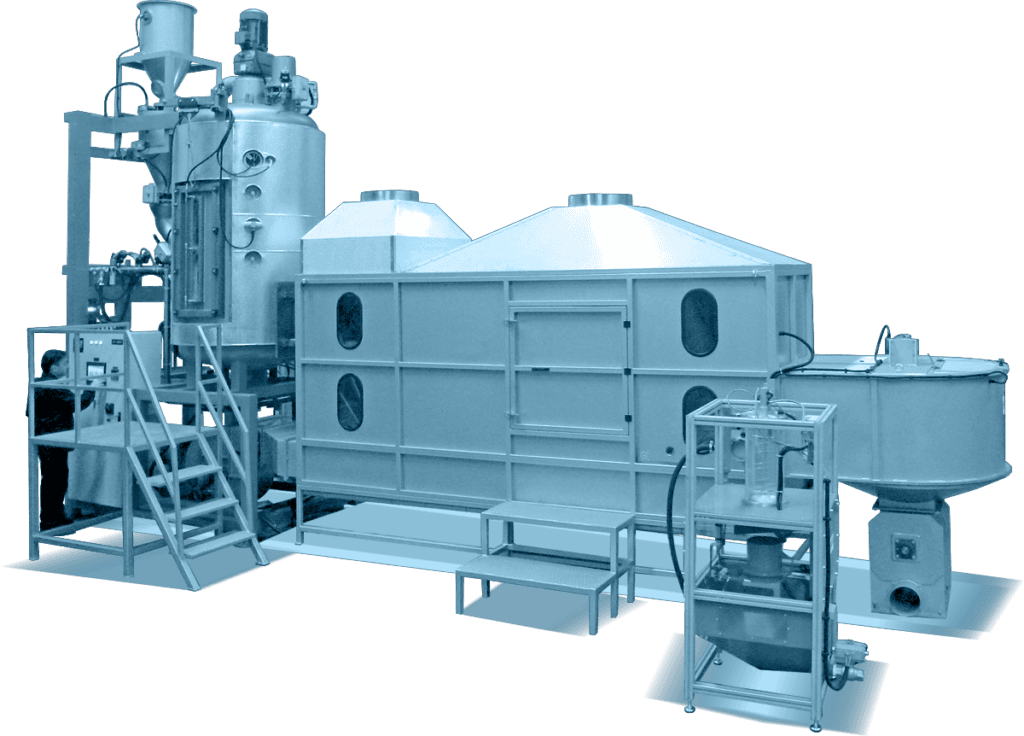
EPS Pre-Expanders (Pre-Foaming Machines)
The pre-foaming machine is the starting point of every EPS line. Eprotech builds pre-expanders in both continuous and discontinuous (batch) configurations, with chamber volumes from 0.15 to 5.5 m³ and throughput capacities from 50 to 4,000 kg/hr. PLC-controlled steam regulation delivers precise density targeting across a working range of 10 to 40 kg/m³.
Batch pre-expanders process a measured charge of beads per cycle, allowing precise density control through automatic weighing and feedback. They are the standard choice for most factories and for products with tight density tolerances. Continuous pre-expanders feed beads through the steam zone without stopping and are used in very high-throughput installations where small density variations are acceptable.
Controlling Density
Density is the single most important variable in EPS product performance, and it is set here during pre-expansion. Target density is governed by steam pressure (typically 0.3 to 0.6 bar), steam exposure time, and material feed rate, all managed automatically by the PLC. Our EPS density guide explains how these variables interact and which density ranges suit which applications.
For tighter tolerance, the pre-foaming machine pairs with an automatic density controller. It samples material from the dryer each cycle, calculates density via a fixed-volume weighing process, and adjusts the next batch’s loading parameters in real time. Live on-screen data and saved or printed production reports support quality documentation and traceability.
Low-Density EPS: Multi Expansion
Standard single-pass pre-expanders reach densities down to approximately 12 kg/m³. For lighter material below 12 kg/m³ (0.75 lb/ft³), used in lightweight packaging, void fill, and acoustic applications, a multi expansion unit provides a controlled second expansion stage. A pre-loading silo with an integrated electronic scale meters the exact quantity of previously expanded material, the PLC calculates the expansion parameters for each phase, and a vacuum fan transfers material into the chamber for consistent, repeatable flow.
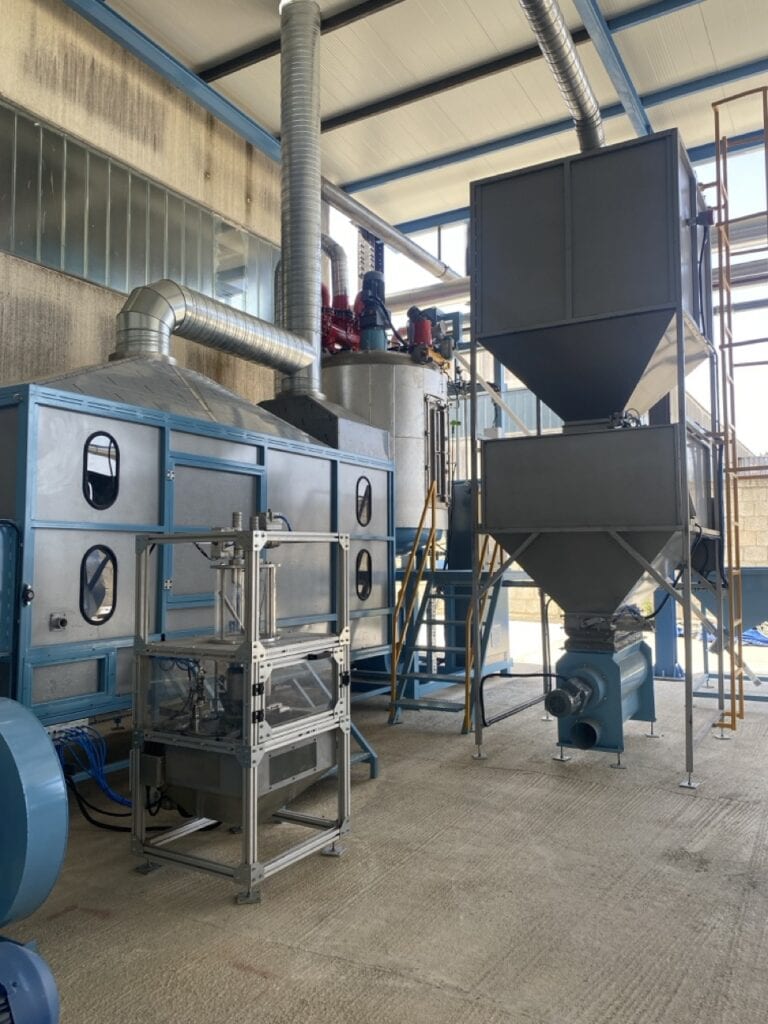
Curing & Aging Silos
Freshly expanded beads retain pentane and have unstable internal pressure, so they are not ready for molding. Curing silos (also called aging or maturation silos) hold the beads while residual moisture evaporates and air diffuses into the cells to restore internal pressure. Standard curing time is 6 to 24 hours, depending on bead size, density, and ambient conditions. Properly cured beads fuse more uniformly during molding and produce stronger, more dimensionally stable products; under-cured beads cause weak bonding, surface defects, and higher scrap. The role of curing in finished-product quality is covered in our EPS quality criteria guide.
Eprotech silos range from 1.5 to 150 m³ (53 to 5,300 ft³) in manual, semi-automatic, and fully automatic configurations. They are made from antistatic synthetic fabric and handle both virgin pre-expanded beads and recycled EPS.
Bead Transfer Between Stages
Bead transfer lines are the pneumatic conveying pipelines that move expanded beads from the pre-foaming machine to the silos, and from the silos onward to molding. Their interiors are smooth and low-friction, and routing avoids sharp turns that crush, deform, or statically charge beads in transit. Well-engineered transfer lines deliver beads to the molding stage in the same condition they left the silo, preserving the density and uniformity established during pre-expansion.
The Next Step in the Line
Cured beads are conveyed to the next stage of production: either EPS block molding, which produces large blocks for subsequent cutting into sheets and panels, or EPS shape molding, which produces finished parts such as packaging inserts and fish boxes directly from the mold. The quality of the beads leaving bead expansion determines how well either process performs.
Machines for This Stage


Frequently Asked Questions
What is the capacity of an EPS pre-expander?
What is the difference between a batch and a continuous pre-expander?
What density range can the machine reach?
How accurate is the automatic density controller?
How long do beads need to cure in the silos before molding?
What size silos are available?
Discuss Your Expansion Requirements
Our engineering team can help you select the right pre-expansion equipment for your capacity and density targets.
Get a Quote