
Two Ways to Mold EPS
Every EPS product begins as pre-expanded, aged beads. The question is how those beads get turned into a finished product. There are two fundamental approaches: block molding and shape molding. They use different machines, serve different markets, and have different economics. Eprotech manufactures the full range of both — EPS block molding machines and EPS shape molding machines, often in the same plant. Choosing between them (or choosing to run both) is one of the first decisions an EPS manufacturer faces when planning a production line.
Block Molding
A block mold produces large rectangular blocks of fused EPS. The blocks are not finished products in themselves; they are intermediate forms that are subsequently cut into boards, sheets, panels, or 3D shapes using EPS block cutting and hot wire machines.
How It Works
- Pre-expanded, aged beads are blown into a large rectangular mold cavity. Common cavity dimensions are 1,000-1,250 mm wide, 500-1,050 mm tall, and 4,000-6,000 mm long, though machines with movable walls can adjust the block width and length.
- Steam is injected through perforated plates on opposite walls of the mold. A typical sequence is: air purge, cross-steaming (steam from one side, then the other), and simultaneous steaming from both sides. Steam pressure is 0.4-0.8 bar gauge.
- After steaming, a vacuum pump draws air and condensate from the mold, flash-cooling the block. This stabilizes the block so it holds its shape after ejection.
- The mold opens and the block is pushed out, typically onto a conveyor that feeds the cutting line.
Production Rate
A well-tuned block mold produces 20-22 blocks per hour, with cycle times of 4-8 minutes depending on block dimensions and target density. Higher density blocks require more steam energy and longer cooling, so they cycle slower. Thicker blocks also take longer because steam must penetrate deeper into the bead bed.
Strengths of Block Molding
- Flexibility: A single block mold can produce material for dozens of different finished product sizes. The block is a blank; the cutting line creates the variety.
- Low tooling cost: No product-specific mold tools are needed. Adjustable walls on the block mold handle different block dimensions.
- Suited to flat products: Insulation boards, facade panels, roof tapers, floor insulation, and sheet goods are natural block-and-cut products.
- CNC contour cutting: Blocks can be fed through CNC hot wire cutters to produce 3D profiles (pipe insulation half-shells, curved architectural elements, or custom packaging shapes) without investing in shape mold tooling.
Limitations
- Post-processing required: Every block must be cut, which adds machines, floor space, labor, and a scrap stream (cutting waste, which an EPS scrap recovery system can return to production).
- Not suited to complex 3D shapes: While CNC cutters can produce many contoured forms, there are geometries (hollow boxes, thin-walled containers, snap-fit packaging) that cannot be wire-cut from a block.
- Surface finish: Cut surfaces expose the internal bead structure of the foam. This is fine for concealed insulation but may not be acceptable for visible consumer products.
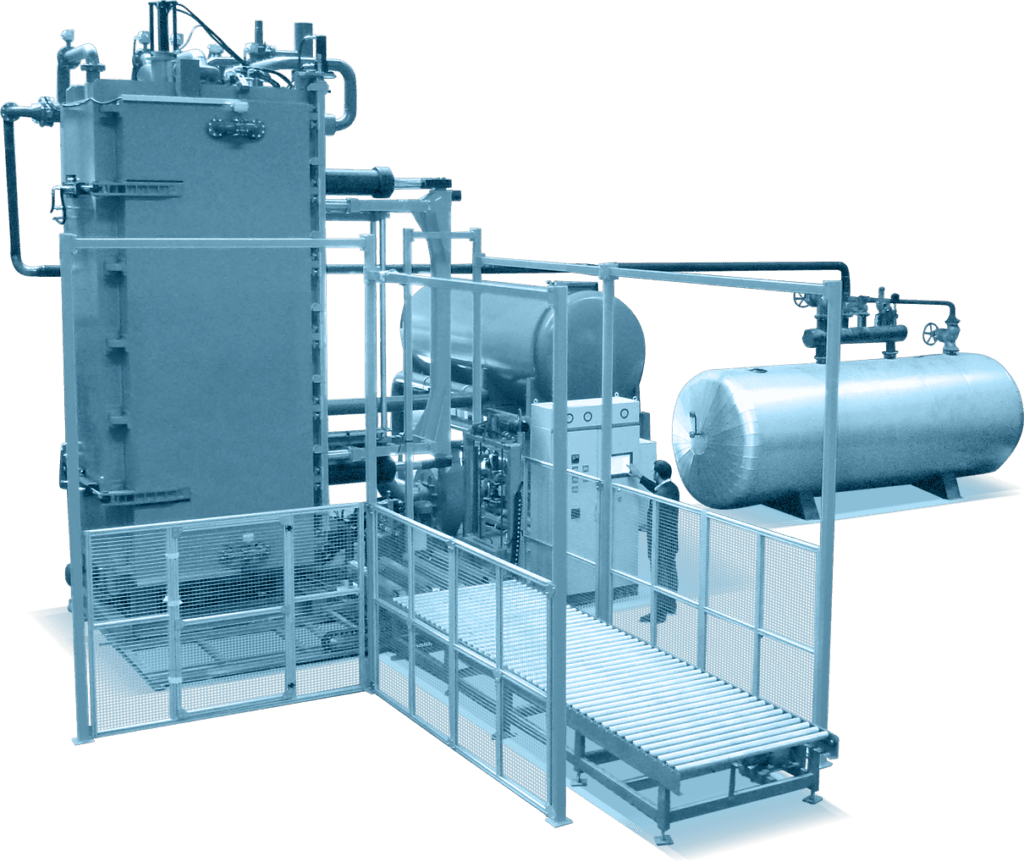
Shape Molding
A shape mold produces finished parts directly. Each product has its own dedicated mold tool that defines the exact geometry of the finished piece. No cutting or secondary shaping is needed.
How It Works
- Beads are injected into a closed two-part mold (male and female halves) through fill guns. The mold can have one cavity or multiple cavities.
- Steam is injected to fuse the beads. The steam cycle is similar to block molding but shorter, typically 20-60 seconds, because the product dimensions are much smaller.
- The mold is cooled (vacuum cooling, water cooling, or both).
- The mold opens and the finished part is ejected, often with compressed air assist.
Production Rate
Cycle times for shape molding are 30-120 seconds per cycle, depending on part size and wall thickness. Multi-cavity molds can produce several parts per cycle. A machine running a 4-cavity fish box mold at a 60-second cycle produces 240 fish boxes per hour. A single-cavity large packaging insert might produce 40-60 parts per hour.
Strengths of Shape Molding
- Finished product from the mold: No cutting, no trimming, no secondary operations. The part comes out ready to use (or ready to stack and ship).
- Complex geometry: Hollow shapes, internal ribs, text and logos, snap-fit features, drainage channels, and thin walls are all possible.
- Smooth surface finish: The molded surface (which forms against the mold wall) is smoother and more uniform than a cut surface.
- High per-part efficiency at volume: Once the mold tool exists, per-part cost is very low because there is no cutting waste and minimal labor.
Limitations
- High tooling cost: Each product requires its own mold tool, which must be designed and manufactured from aluminum. Mold tools cost thousands to tens of thousands of dollars depending on size and complexity.
- Dedicated to one product: A mold tool makes one shape. Changing to a different product means changing the mold, which takes time (30 minutes to several hours depending on mold size and machine type).
- Less flexible for small runs: The tooling investment is only justified at sufficient production volume. For a product that sells a few hundred pieces per year, block-and-cut is almost always cheaper.
Side-by-Side Comparison
| Criterion | Block Molding | Shape Molding |
|---|---|---|
| Output | Large rectangular blocks (intermediate product) | Finished parts (final product) |
| Post-processing | Required (cutting, trimming) | None or minimal |
| Product geometry | Flat boards, sheets, CNC-cut 3D profiles | Any moldable 3D shape |
| Surface finish | Cut surface (exposed bead structure) | Molded surface (smooth skin) |
| Tooling cost | Low (adjustable mold walls only) | High (custom mold per product) |
| Product changeover | Change cutting program (minutes) | Change mold tool (30 min to hours) |
| Typical throughput | 20-22 blocks/hour | 30-120 second cycle, varies by cavity count |
| Material waste | 10-20% cutting scrap (recyclable) | Less than 2% (flash and fill waste) |
| Per-unit cost at volume | Higher (cutting labor and scrap) | Lower (no secondary operations) |
| Capital investment | Moderate (block mold + cutting line) | Higher (shape mold machine + mold tools) |
| Best suited for | Insulation boards, sheets, geofoam, custom-cut shapes | Packaging, fish boxes, helmets, custom molded parts |
When to Choose Block Molding
Block molding is the right choice when:
- The primary products are flat boards and panels (insulation, facade, roofing).
- Product dimensions change frequently (different thicknesses, widths, lengths) and flexibility is valued.
- Production volumes per SKU are moderate and do not justify dedicated mold tooling.
- The factory serves the construction market, where cut boards are the standard product form.
- 3D shapes are needed occasionally and can be handled by EPS block cutting and CNC contour cutting equipment.
When to Choose Shape Molding
Shape molding is the right choice when:
- Products have complex 3D geometry that cannot be wire-cut from a block.
- Surface finish matters (consumer-facing products, branded packaging).
- Production volumes per SKU are high enough to amortize the mold tool cost.
- The factory serves the packaging, food service, or consumer product markets.
- Per-unit cost must be minimized for competitive pricing at volume.
When You Need Both
Many EPS manufacturers run both block molds and shape molds in the same factory. A typical combination is a block mold line feeding a cutting department for insulation products, plus one or more shape mold machines producing packaging or food containers. The two lines share the same pre-expander, aging silos, steam boiler, and compressed air system, so the incremental cost of adding the second process is mainly the molding machine itself and its tooling inventory. Our turnkey EPS plant engineering projects routinely combine both lines on shared pre-expansion and aging infrastructure.
Running both processes also provides revenue diversification. Construction and packaging markets have different seasonal cycles and different sensitivity to economic conditions. A factory that can serve both is more resilient than one that depends on a single market.
The choice between block molding and shape molding is not a matter of one being better than the other. It is a matter of matching the process to the product, the market, and the production volume. Getting this match right at the planning stage avoids costly retrofits later. To map specific products to each process, see EPS applications by industry, and for the full equipment line that supports either route, see our EPS production machines guide.